• ABOUT
  • SERVICES
  • WORK
  • PEOPLE
  • SPACE
  • PARTNERS
  • BLOG
  • CONTACT
  • IMDB

Foley

SFX Tattoo Machine Box Art Sfx Library Sound Effects Sound Design

Inked & Mic’d Up: Introducing Our Tattoo Machine SFX Library

October 11, 2023

Buzzzzzzzzzz…… What’s that sound? Does your sound effects library need some new ink?! We have the perfect tattoo machine sound effects library for you.

We think our Tattoo Machine sound effects will be a great permanent addition to your library. We brought in a professional tattoo artist to perform various techniques at different speeds with multiple needles… Capturing close up detailed mechanics as well as perspectives of full tattoo pieces. Whether it’s a small tattoo or a full chest piece, these sound effects have you covered… in ink.

That’s not all this library has up it’s sleeve… Recorded at 192kHz to capture ultrasonic content, “Tattoo Machine” is a new tool your sound design kit needs. The buzz of line work becomes detailed mechanical pulses when slowed down. Tattoo machine voltage and speed ramps make for a perfect base to a whirring sci-fi vehicle. All of this for a price that won’t cause your wallet any blowout. Check out all that “Tattoo Machine” has to offer!


Machine Master – Rafael Corona
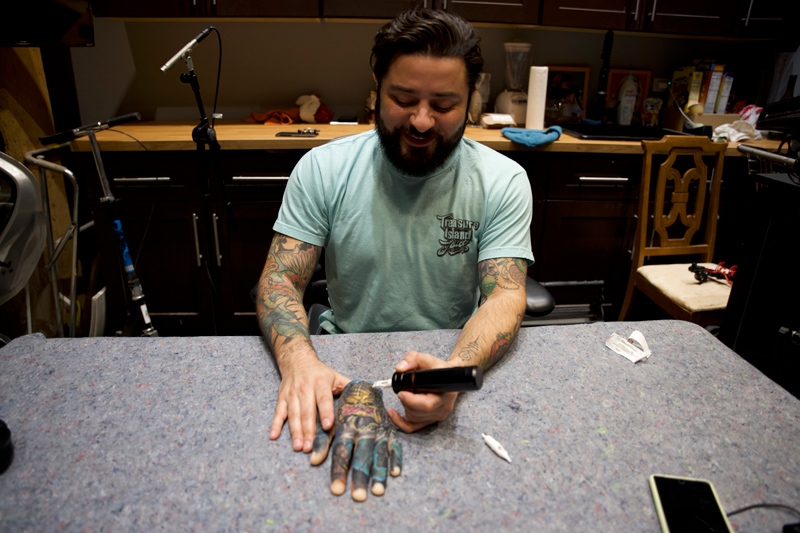
 

Local artist Rafael Corona from Mayday Tattoo Studios has been tattooing for 20 years and completed thousands of tattoos – but “I have never been asked to do anything remotely close to the amazing recording we did for Noisefloor.”

Specializing in color illustrative tattoos, Corona was more than up to the task of completing a full piece during the recording session. And whether it’s for a SFX library or a client, “Every time I create a piece of art for someone I practice my studies. It is crucial to at least consider all corners of art theory to make the best work. Color theory, value scales, line weight, balance, contrast, and how to emphasize based on the project are very important. Everyone is different, and so listening and getting to know an individual helps with designing the best custom, one-of-a-kind, permanent piece.”


Meet the Creatives
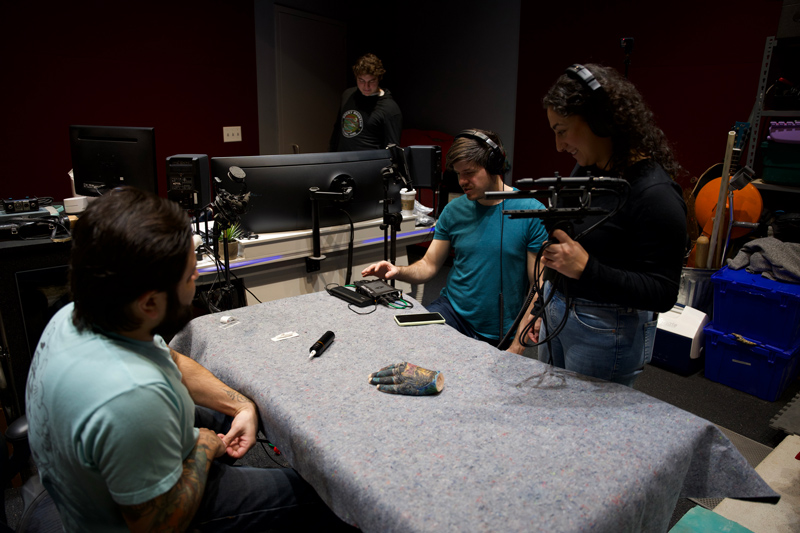
 

creatives recording sound

Noisefloor’s Stosh Tuszynski and Victoria Salazar were the sound effects recordists for the session, and they provide some insight on the making of the library.

Were they any special considerations you had to take into account with the high frequencies or extraneous noise of the tattoo machine?

Stosh: Yes, we definitely wanted to consider if there was going to be noise in the high frequency range beyond human hearing that would be heard when slowed down. We didn’t know for sure, but because of how fast the machine was going and how small the parts were we prepared for that by using Sanken Co-100k – which captures up to 100kHz. Because we were recording ultrasonic information, we had to make sure we had both a microphone and a recorder that could capture that high of a frequency.

Did you stay organized via metadata, verbal slating, or a combination of both?

Stosh: It was mostly verbal slating. Before we got started, we sketched out a rough idea of the kind of performances we wanted to capture and what would be useful to sound editors. Different techniques, speeds, and pressures were all put into a list that we showed the tattoo artist which ended up being 3-4 basic movements that we captured. Luckily, we also had a Go-Pro rolling for the duration of the recording process, so we were able to decipher the entire context of the conversation for metadata purposes later.

What parameters did you consider when choosing the microphone for capturing the tattoo SFX?
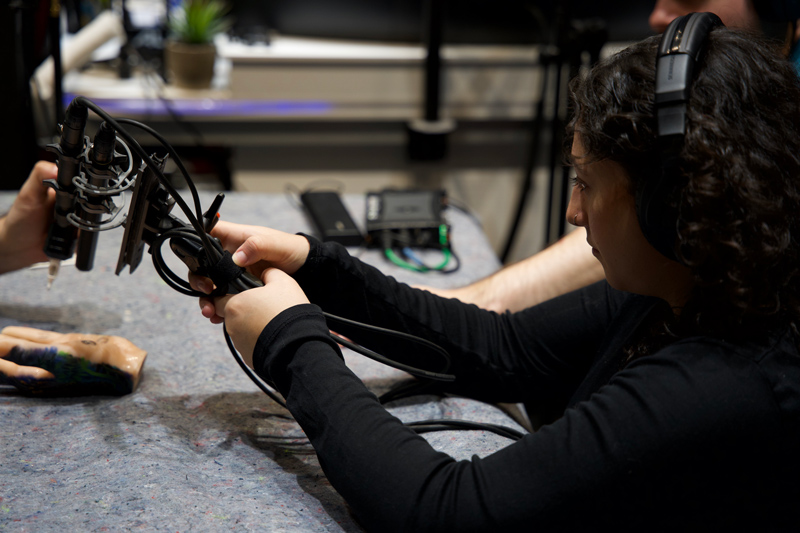
 

woman recording sound

Victoria: We were trying to figure out what we wanted to get out of the library. One of the main things was for sound designers to be able to pitch the effects up and down, and having the information to be able to do so. Stosh brought in his Sanken Co-100K and MKH 8040’s. With the Sanken we were able to get those detailed movements, and the 8040’s in an X-Y setup do a great job of capturing the overall ambience of the room.

When capturing different perspectives in the room, did you have a rule of thumb for the proximity between the microphone and the machine?

Victoria: I stayed within a few inches to get that detail of the needle on the fake hand, and it had this really cool low-end resonance to it. It was definitely exploratory, and I basically determined the distance by listening to it and adjusting from there. For the X-Y setup, we set it up about two feet above the machine to get the full room perspective.
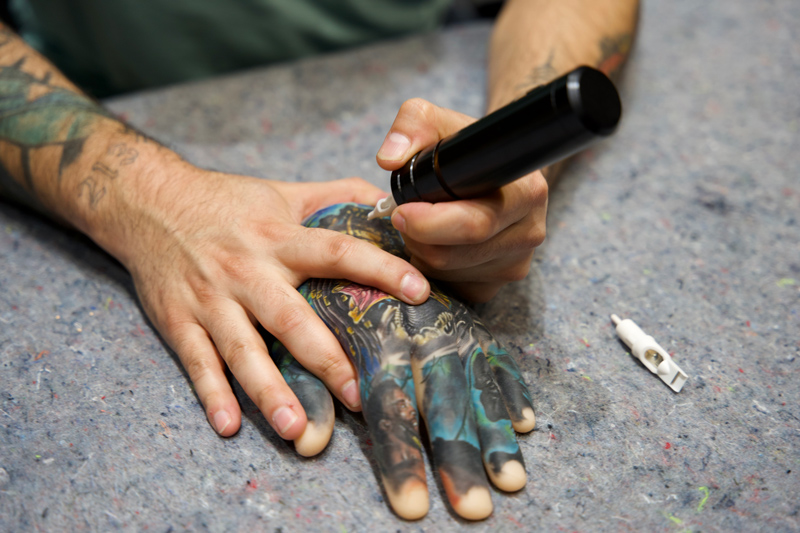
 

close up of tattoo artist

Besides being practically useful to sound editors, what other creative sound design possibilities can you envision being achieved with this library?

Stosh: For me, it screams sci-fi, futuristic vehicular sounds. There’s a lot of variation in pitch and speed that I can see being really useful for a spaceship because of some of the neat doppler sounds or even rattly user interface effects.

Victoria: Importing at 192KHZ and having the ultrasonic information could be used for cool creature sounds or a giant robot – anything super mechanical. Or even reversing it and seeing what kind of warp sounds can be made from it.
 

Purchase Library
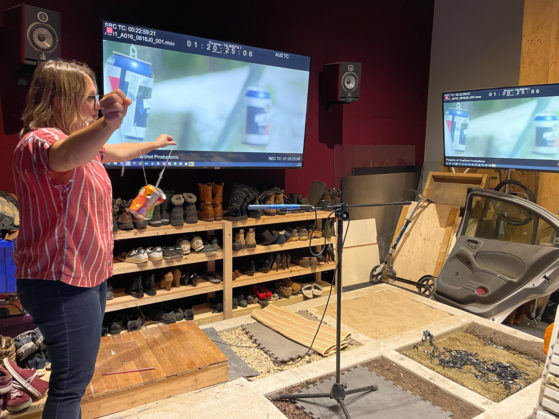
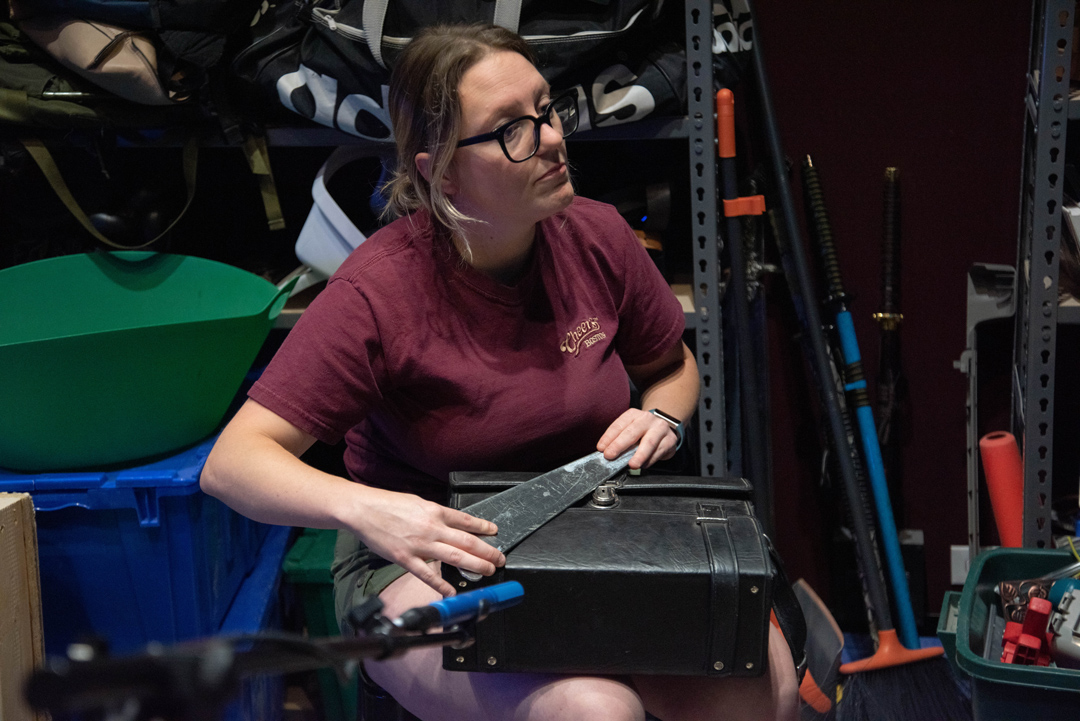
Sound designer creating foley

Unveiling the Art of Foley: Crafting Realism in Soundscapes

September 29, 2023

When you watch a movie or play a video game, the world you experience is a symphony of sights and sounds that blend seamlessly to create an immersive experience. While visual effects and storytelling play vital roles, the unsung heroes behind the scenes, known as Foley Artists, contribute a significant part in bringing these audiovisual narratives to life. In this article, we’ll dive deep into the fascinating world of Foley, exploring how these talented individuals craft realism in soundscapes.

What is Foley?

Sound designer creating foley

Foley is a specialized craft in the realm of sound design, named after Jack Foley, an early pioneer in the field. It was the 1920’s where Jack invented the artistic process of Foley and how it would bring life to stories, first through live radio, but later on the craft would be needed for other audio mediums like video games, film, and podcasts. Foley Artists are responsible for creating and recording the everyday sounds that enhance the authenticity of a scene, even when the original production audio falls short.

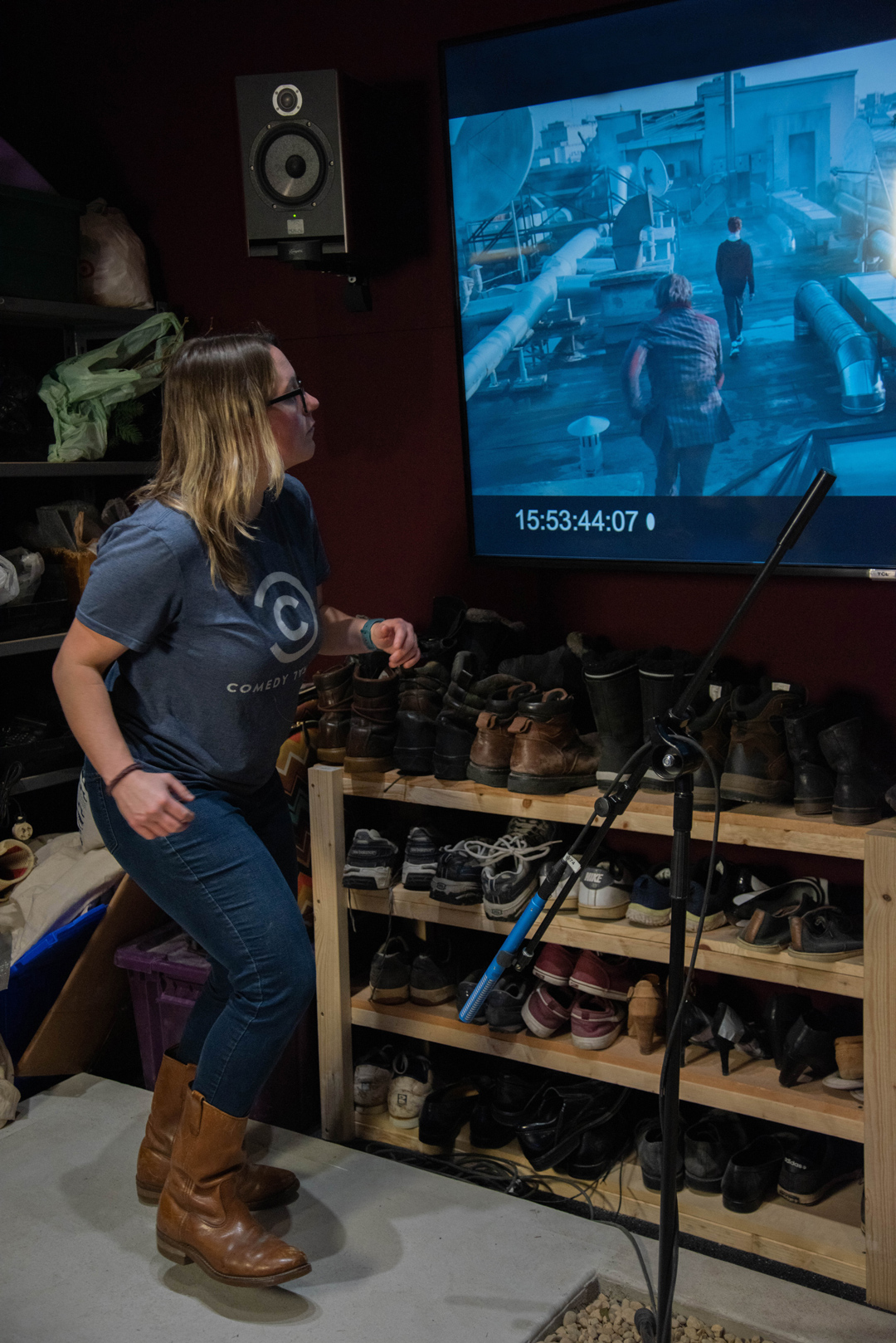
Imagine a scene in which a character walks on gravel, picks up a coffee cup, or sits in a chair. These seemingly mundane actions, when captured with precision, can enhance the viewer’s emotional connection and understanding of the story. Foley Artists meticulously recreate these sounds using a variety of props, surfaces, cloth and recording techniques to produce audio that syncs with the on-screen action. Or for projects with no visual, the Foley Artist works with the dialogue, narration, and Audio Directors or Sound Supervisors of the project to create the necessary sounds that will aid in making an audio experience for the listener.

Crafting Realism

Sound designer creating foley

The heart of Foley lies in the pursuit of realism. Every footstep, every rustle of clothing, and every creak of a floorboard must be tailored to fit the unique context of the scene. Foley Artists immerse themselves in the characters’ world, envisioning their movements and interactions to create a convincing auditory experience.

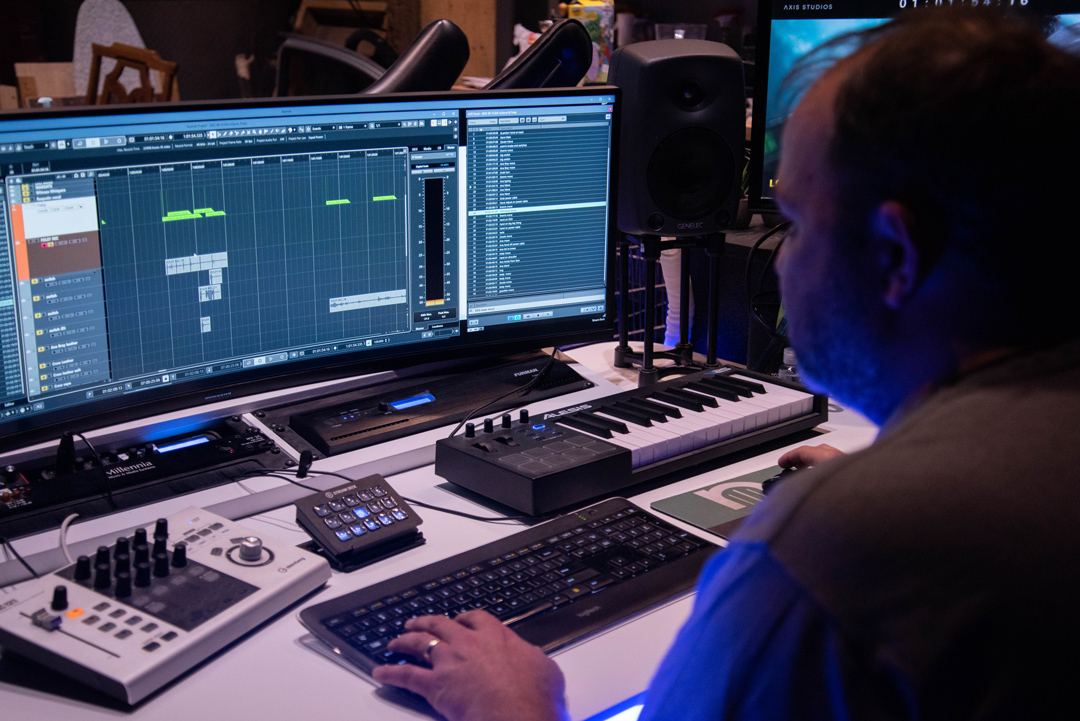
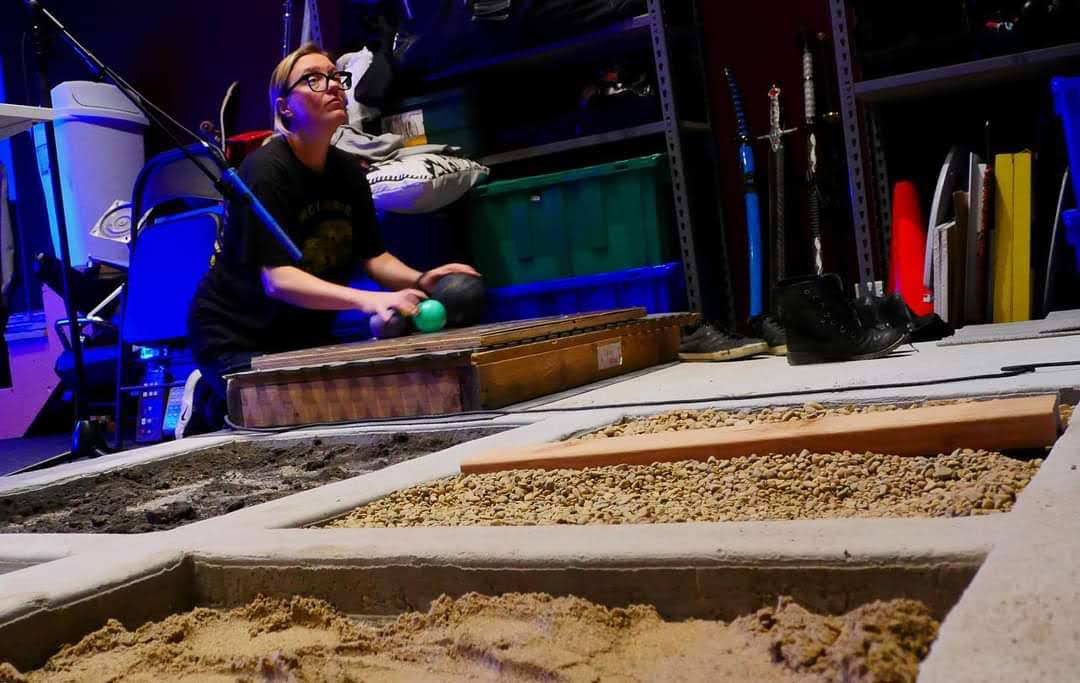
To capture the sound of footsteps during the recording session, Foley Artists may use different shoes on various surfaces, like gravel, wood, or carpet, to simulate different terrains. The Foley Artist works closely with a Foley Mixer who is responsible for recording the sound effects the majority of the time using a Digital Audio Workstation (ie. DAW) and capturing a high quality recording along with the accurate perspective of the sound. Sometimes the Foley team may go to a location to record something specific that can not be recorded on the Foley stage or possibly for a reason there are benefits of recording a specific sound on location. The Foley Artist and Foley Mixer work together to ensure the sounds are right and the two are happy before it moves on to the next Foley team member. Once the sound effects are recorded, the audio is then carefully synchronized by a Foley Editor with the visuals (if any) to create a harmonious blend of sound and image.

The Art of Creativity

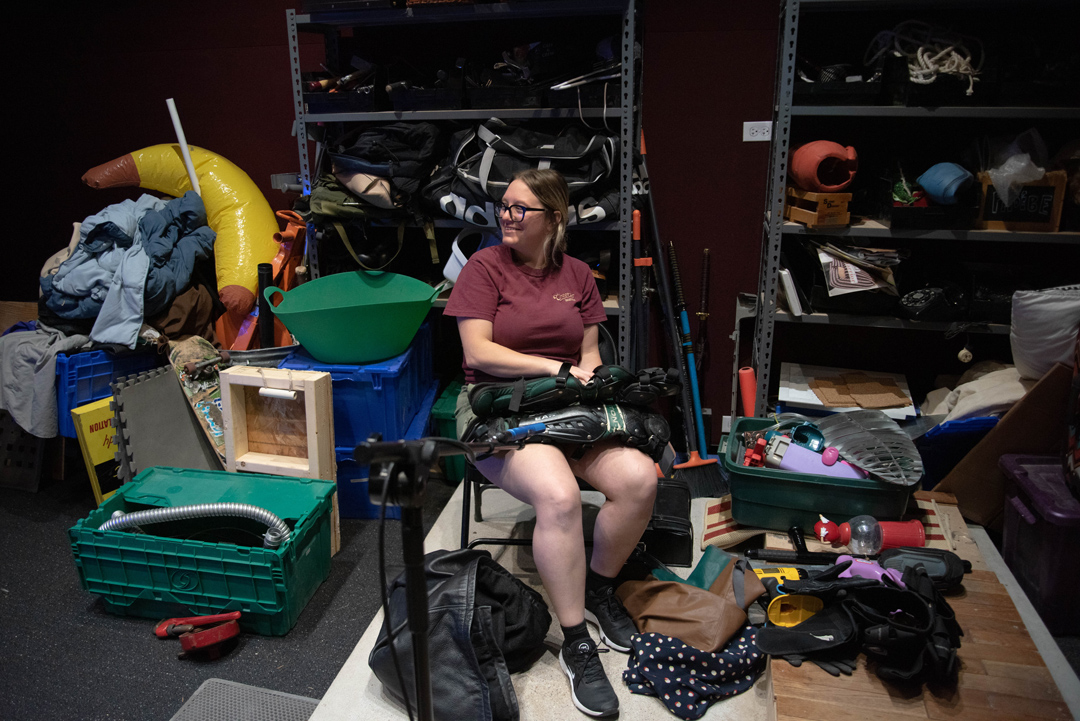
Foley is both a science and an art, similar to the art of a painter. While technical precision is essential, creativity also plays a significant role. Sometimes, sounds need to be exaggerated to enhance their impact. For instance, the cracking of a thunderbolt might involve crushing a bag of potato chips to create a larger-than-life sound that resonates with the audience. One interesting thing about Foley is it’s not always the actual object that makes the sound you need. And it’s not only one prop that can work for a specific sound. Kissing apples or kissing your hand both work for kissing sounds. A Foley Artist sitting in a chair or using cloth pressed into a chair both work for characters sitting. A hand drill can work for the sound of handling a handgun. If the sound is believable and it works when listening to it, then the Foley team is happy. Noisefloor’s Foley Artist Katie Waters says, “When I first started doing Foley I found myself looking for the actual prop to use for the prop I needed, for example a leather wallet for a leather wallet. I’ve learned with experience, it’s breaking down the materials that create a sound. Now if I have a piece of thick leather paired with some dollar bills I can create the sound of someone pulling cash out of their wallet. I embrace the challenge to dissect what I see, I likely have a sound in my mind for those elements and go hunt for props to emulate the whole prop.”

The Magic Behind the Scenes

sound designer working at computer

Next time you’re immersed in a movie or a game, pay attention to the details that you hear. The squeak of a door, the clinking of glasses, or the subtle rustle of clothing – these are the fruits of the labor of Foley Artists. Their dedication to authenticity elevates storytelling, drawing audiences into the narrative in ways they might not even consciously recognize. “I love to see a project in it’s entirety first before hitting the ground working so I can get to know the characters and the story. It’s nice to experience something as an audience would and then ask myself, what can I add to this to amplify it?” says Katie.

Sound designer creating foley

In a world where both audio and audiovisual experiences have become increasingly sophisticated, the role of a Foley Artist remains as relevant and crucial as ever. So, the next time you’re moved by the subtlety of a sound in a movie or a game, remember that there’s a Foley Artist behind that magic, sculpting the world of sound one meticulously crafted sound effect at a time. “Our role is like a sound scientist. We dissect what we see or what we envision for a sound, gather the chemicals and mix them together to create a tasteful masterpiece. I think Foley Artists are much like Professor Philip Brainard (Robin Williams in the movie Flubber). When you’ve blended these layers that make one thing, it can be a very satisfying moment to experience when listening back to it. Hopefully the audience doesn’t notice it though. I just want it to be there, a part of the world, and it feels real, no questions asked.”

Sound designer creating foley

Search

Sound specialists for Film, TV, Radio, Web, Video Game, Interactive Projects.

© 2025 Noisefloor Sound Solutions. Website by On Your Mark.
Insert/edit link

Enter the destination URL

Or link to existing content

    No search term specified. Showing recent items. Search or use up and down arrow keys to select an item.